Insights OpenText


And what happens when it isn't

Every CCM platform — whether it's OpenText Exstream, Quadient Inspire, or SMART Communications — has the same hidden risk built into it: a small change to a template, a data mapping, or a configuration setting can silently break dozens of documents downstream. The change goes live. Nobody notices until a customer calls, or an auditor asks why their statement looks different this quarter.
This is not a hypothetical. It's one of the most common — and most avoidable — problems in CCM production environments. And the fix is not more manual checking. The fix is automated CCM regression testing.
Most CCM teams have a testing process. They review output samples before a release, compare PDFs side by side, and run through a checklist. It works — until it doesn't.
Manual testing has three fundamental problems in a CCM context:
The question isn't whether your CCM output will ever break. It's whether you'll find out before or after your customers do.
Regression testing in a CCM environment is not about catching obvious bugs. It's about catching the subtle drift that accumulates over time: a field that used to render correctly now truncates, a conditional block that fires when it shouldn't, a PDF that looks right on screen but fails print production spec.
Every time a template is edited — even a minor copy change — the full document family it belongs to should be validated. Automated tests compare new outputs against approved baselines and flag any deviation, including layout shifts, missing content, and changed formatting.
CCM platforms don't live in isolation. They receive data from ERP systems, CRM platforms, and integration layers. Automated API tests validate that the connections your documents depend on are returning the right data, in the right format, with the right authentication — before every deployment.
A document destined for print has different requirements than one delivered by email, portal, or Kivra. Regression tests can be scoped per channel, catching issues that only surface in specific output paths.
One of the most common reasons CCM teams resist automation is the setup cost. "We'd spend more time building the tests than running them manually." This calculus shifts quickly once you factor in the real cost of the alternative: a release that breaks something in production, a weekend spent diagnosing and rolling back, and the reputational cost of incorrect customer communications going out at scale.
Automated regression tests, once built, run in minutes. They run consistently every time. And they give process owners and product owners something genuinely useful: a clear pass/fail status before a release decision is made. Not a list of things that were checked, but a verifiable result.
For organisations running regular CCM releases — monthly, biweekly, or faster — this is the difference between a release process that feels controlled and one that feels like a gamble.
Organisations that have invested in automated CCM regression testing typically share a few characteristics:
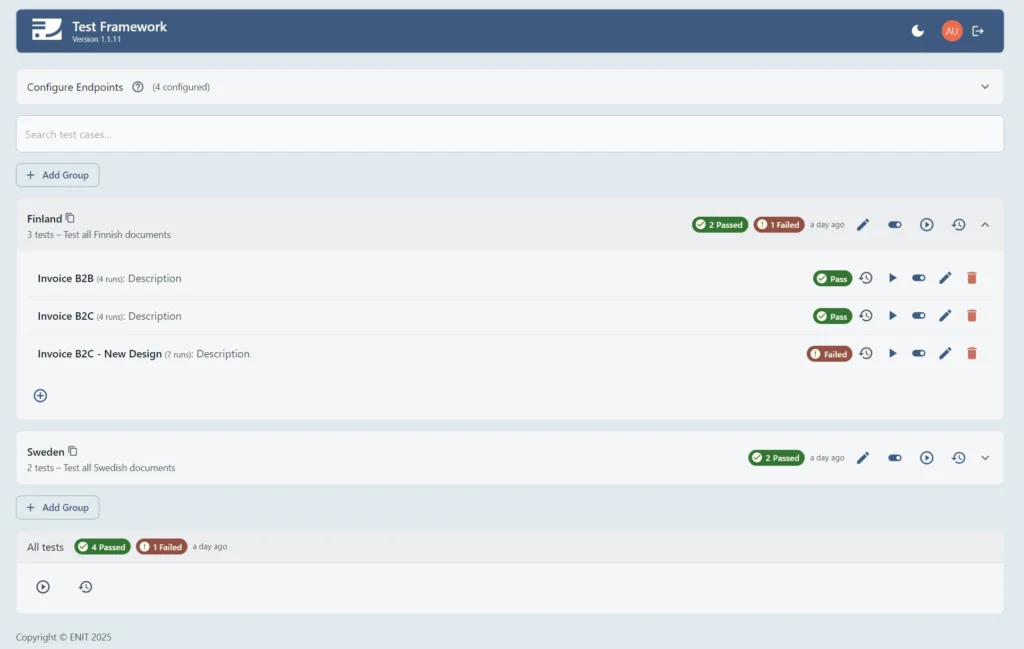
Here is ENIT Test Framework dashboard showing automated CCM test results.
You don't need to automate everything at once. A practical starting point:
The goal in the first phase isn't complete coverage. It's establishing the habit and the tooling — and demonstrating to the organisation that release confidence doesn't have to come from hope.

About ENIT
We assist clients in developing and digitizing their customer communication solutions by providing consulting services and tailored solutions within OpenText Exstream, Quadient Inspire and SmartCOMM.

Let's talk about your next project
Here you will find contact information — email, LinkedIn — so that you always know where we are.
"*" indicates required fields